Thursday, March 31, 2011

British People Sound Smart

I do not particularly like sending people away from this site, but The Telegraph Newspaper website does not seem to encourage embedding of their videos, so there you go.


The Cult of Beauty at the V&A: curator interview

Exhibition curator Stephen Galloway explains the enduring appeal of the Victorian Aesthetic movement to Alastair Smart.

I did not authorize their use of my portrait

Tuesday, March 29, 2011

This Totally (Almost) Happened (Part 2)

OK, here is the final inked version of the page I displayed in the last post.  I made some changes and repairs using a pencil, did some erasing and re-penciling, and then I inked.  I then erased some pencil lines using a kneaded eraser and then went back over spots that needed more ink.  You'll notice that I leave a blank/black space in the title.  I envisioned using this title panel again for other works, but I do not like how I inked the letters, so I think this was a one-off title panel. I may need to stick with computer-generated text.
Final inks

This is a problem I have encountered before.  I prefer Yasutomo ink when using a brush; however, if you leave even the slightest hint of non-reproducing blue colored pencil, then the Yasutomo ink tends to roll off the pencil marks.  Acrylic ink works better, but overall I prefer the Yasutomo.  So, what to do?  Well, first I should have been more vigilant and done a more thorough erasing job (of the blue pencil) before laying down final graphite pencils.  Yasutomo seems to have no problem laying on graphite pencil. Go figure.

I will say this, though.  I almost chickened out and started using a nib pen on some of these lines, but I ploughed ahead undaunted.  I used a Raphael kolinsky sable brush #0 for every line you see here.  All brush, baby.  I am more than a little proud of myself.  Are there issues and problems and some mislaid lines?  Sure, of course there are, but practice makes perfect, and I enjoyed every brush line of this drawing. Below is the scanned, lettered, half-toned final product.  I may go back and make this a robin's egg monochrome or a orange creamsicle monochrome like some of my other pieces, but for now it will stay gray.
Scanned, with text and half-tone effects added in Paint Shop Pro
Questions: How much of this story is true?  Not much, but the bar I drew from my memory impressions was very cool (The Perch Pub in Philly), and Gandhi was discussed briefly, and today I bought a new biography on Gandhi, so I think it is appropriate that I finish this piece tonight.  Was some lady really gabbing on like that? There was at least one lady and one guy who were way too loud and they were leaning on and bumping into the backs of people's chairs, so one or two people needed an elbowing.  What are those squiggly lines in panel #3?  I don't know, annoyance of some kind?  It looks more like spidey-sense, but I will go with annoyance.  That fight scene looks weird, what's up with that? I am not a connoisseur of manga and anime, but I do find it intriguing in Japanese (and Japanese-inspired) cartoons that when a character is in a state of high emotion, they change the art style, it becomes very sketchy and there is movement and the art is simplified.  It is odd.  So, I wanted the lady being pummeled to have those X'd out eyes and I wanted the moving arm to be fluid and "not quite there."  What are those things on the bar in that first panel?  Deviled eggs made with sriracha.  Delicious.

Sunday, March 27, 2011

This Totally (Almost) Happened (Part 1)

OK, so I like to elaborate, sometimes exaggerate, maybe perchance fabulate (as in fabulist) when I translate real life events into drawings, so I think I am going to try using the title This Totally (Almost) Happened when drawing such misadventures.  You will see in the page below that I will be leaving some room to fill in the blank as to the date on which the events transpire.  I include an image of the thumbnail sketches to show that what I initially come up with extremely "bare bones" in nature.  I think I actually decided I wanted the format of 1/3 title, 2/3 panel, then 2 panels and 2 panels (5 panels of art/text total) and then made it fit into that space, which could have failed miserably.  I don't recommend doing that ever.  I think the best way is to really flesh out the script until it is finalized, then start translating the pictures you see in your head as you read your own script.  Then you can start playing around with how many panels and in what transition.

This sketchbook measures 11" x 14", so you can see that thumbnails on the right are pretty small.  I find that it is easier to take what is in your brain and fit the real basic lines of the scene into a much smaller space.

Above is the non-reproducing blue colored pencil sketch.  I have taken my mini thumbnail sketches and tried to enlarge them into the larger panels, trying to keep the overall look and proportions.  So, how the space of the figures and text boxes are similar, then it is a matter of filling in the details.
Here is the finished pencil sketch.  I've made some changes, added some details, and you might be thinking, "this does not look finished", which is true, but early on I decided that I would do this with ink and brush, so the pencil sketch only has to be "finished" enough" for me to move on to the brush stage.  I never stay exactly in between or on the lines with a brush anyway, so there is no use in making the pencil sketch super detailed or finely lined.  There is going to be a lot of play when it comes to the brush work.  If I decide that I would use a pen, I would go in and do a lot more detail, a higher quantity of lines, shade in black space more precisely so I could trace over every line with the pen.

Obviously, I have left out the text, because I am going to add that in on the computer.

Next post will be the final inked, scanned, text-added product.

Friday, March 25, 2011

Cat Cult Concept Art (Part II)

Okay, so after a couple cups of coffee, I managed to stay up to ink this page and then scan it.  As you can see, there are no blue lines.  The outlines, the hash marks, the ruled lines, my hand-written notes: all gone, because I scanned in B&W mode, thus removing all the non-reproducing blue. 
I added some grays using the computer.  Quick stuff, just to throw some shadows in there.  It makes me think that an actual page (or maybe I will revise this one) should not depend on computer-added shadow.  I am thinking I should ink the shit out of this puppy.  Lots of shadow, lots of hatch-crossing, make it very dark so that the white space really stands out.  Draw in all the fluting of the columns, add some decorative motifs to the arches.  In other words, don't leave a single square inch of bristol board unscratched.

Thursday, March 24, 2011

Cat Cult Concept Art (Documenting a Process)

I love the documenting of an art project of any kind.  To see how someone or a collective take an artistic project from concept to completion, the mind's eye to paper, I think this is great, and I try to do that here when I can.  With that in mind, let me make a shoutout to Daredevil Chicken.
What is Daredevil Chicken?  Well, Scott Nelson and Jannie Ho write,
Daredevil Chicken is a project started by Scott Nelson and Jannie Ho. What happens when two artists with two different styles collaborate and work on a 32-page picture book about a daredevil chicken? Follow along and see what happens!
Sounds pretty awesome to me.  This is also proves that not everything on Twitter is complete crap, because I found Daredevil Chicken through Twitter @JannieHo.  Good luck, folks!  I plan to check back often to see the progress.

As for me, I have begun a collaboration with another artist on a project entitled Cat Cult.  Another reason why I mention Daredevil Chicken is that Scott and Jannie are trying to combine/collaborate with two different art styles, and the same goes here.  Although the art below is all mine, we are trying to divvy up / co-work in panels and pages together with two fairly different art styles.  If I went into details as to the concept and the meaning behind this project, it might just blow your mind, so let's skip that.  Just know that I sharpened up my true blue non-reproducing colored pencil and some H's and HB's, fired up the Epson, and started sketching.  I have mentioned this before, but non-reproducing blue is great, because you can write notes and do lots of revisions to a piece of art without having to worry about it showing up in the scan or a copy.  Let me set the scene: two characters go to a motel for an investigation of sorts, but the motel they go has some surprises in store for them.  All is not what it seems. Here is the first draft layout.  Again, this is concept art, it's just ideas.  Actually, my collaborator has not approved this in any way, and it is possible that not a single panel of the work will look anything like this.


The blue lines are blue colored pencil, obviously.  The darker lines are H or HB pencil.  I find that blue pencil does not really ever fully erase, even with a good eraser, so what I tend to do is make adjustments to the blue lines with a regular pencil, then I can easily erase the regular pencil and re-work it, keeping the remnants of the blue lines and I can see how it started and then progressed.


As you can see, I want to use perspective on the final panel, but I still need to decide exactly how that will look and where the vanishing point will be.  You can see that the pointed arch (Gothic style) doors on either side are uneven and the arches that disappear being the desk (at the center) are not worked out yet.  It could be a job for heavy use of shadow to make it more mysterious, but also to blur out some potentially complicated architectural drawing  I went back and forth about doing the columns and arches.  They would make for a dramatic scene, lots of opportunity for details being worked in amongst the architectural design.  It will, however, take more planning and sketching and will be fairly painstaking in terms of final layout sketches and inking. I am going to post this now, but I will be trying to re-work this page and post a second version tonight.

Magic Posters Are Cool

So, today is Harry Houdini's birthday, and Google created a really cool Houdini poster take on the Google logo.
This is pretty cool.  It invokes the style of the early magic posters: bold colors, bold lettering, always a picture of the performer doing something spectacular.  And I like Google's use of the drop shadow to drive home the point that it is supposed to resemble an actual paper poster, the kind of broadside advertisements hung outside theaters and other venues.

Here are some other examples.  This one seems like the people at Google may have been looking at this particular poster or something very similar to it.  Notice the similarities in the font.
Houdini: The World's Handcuff King and Prison Breaker
This one below doesn't have any spectacular trick being performed, so it looks like they went with more in terms of decoration.  And the portrait seems to simulate a photograph more than the "illustration" depiction in the poster above.
Harry Houdini: King of Cards
Getting away from Houdini, here is another magic poster, and it is quite different.  This poster is "all trick."  Swanky decor and rugs (and the kneeling Indian servant) were meant to give this act/performance an air of exotic mysticism.  I will get into the racist undertones regarding the concept of the "inscrutable exotic" some other time.  But I do think it is interesting that there is a shift here.  The focus is NOT on the performer.  Houdini was a huge name in his day, so it would make sense that his face be at the forefront.  His posters featured his name and face recognition.  In the poster below, the focus is clearly on the act or "feat of magic" or illusion and the mood and atmosphere of the performance.  It is focused on the spectacle of the event rather than the performer.  I think there is also an attempt to convince the viewer that this is reality.  There are no vignettes or up-close portraits.  Although the poster looks nothing like a photograph, the fact that the composition is done in a realistic style, using perspective and no extraneous adornment, the promoters may have been trying to pass this off as a kind of illustration of reality.  In other words, real levitation.  Magicians use parlour tricks and sleight of hand, but this is what you will witness at the performance: levitation.  And if paying customers walked in and saw three people dressed similar as to how they are depicted, the background scenery a duplicate of the poster, they may be more inclined to believe what they see is reality.  That's just my take, though.
Kellar: Levitation
And finally, we have this poster: Carter the Great, who is, apparently, the world's weird, wonderful wizard.  This poster is pretty awesome, because it is a work of art.  Fanciful figures, lush color palette, and the performer isn't hamming it up for the poster (see below).  He seems intent on something.  I think this provides as nice contrast to the poster above.  There is no pretension of representing reality.  This is fantasy, imagination, and artistic expression.  It is beautiful to look at.  I would steal this poster.
Carter The Great
A similar poster for Carter the Great was used for the novel Carter Beats the Devil by Glen David Gould.  I have not read it myself, but if it involves a magician and the Devil, I might very well be interested.


Monday, March 21, 2011

Duke McMahon is Coming to Town

Evil Publishing Mogul Attempting Hostile Takeover of Ink Puddle

Harrison Spate - evil publishing mogul, rival comix creator, and former colleague of yours truly - has been trying to divert time, energy, and resources away from The Ink Puddle Art Blog.  At the moment, his true motives for this unprecedented maneuver remain veiled in secrecy.
Spate with jezebels
Primarily known for his failed publication Cat Cult, Spate made it a point to be seen with the most famous and infamous of personages imaginable.
Spate with disgraced politician Tom Delay
Once being quoted as saying "Gatsby ain't got shit on me!", Spate established his playboy cred by throwing lavish parties on his compound.
Spate with harlots
Spate couldn't help but cheat, steal, and cheat his way to the top of whatever game he was playing.
Spate with Abramoff
It didn't matter who he had to step over, even his own country.
Spate with Osama
It is true that in the present economy, The Ink Puddle Art Blog has been looking for strategic partners in the publishing and graphic arts industries, but this is not something we were looking for at all.  I will keep you updated as to how this whole Harrison Spate thing develops.  For now, on behalf of everyone here working on The Ink Puddle Art Blog, we thank you for your continued support.

Friday, March 18, 2011

Philadelphia From Above (Photograph)

Philadelphia from 19 floors up.
Contrasted and saturated to hell, but I think now you can better see the "block" shapes all throughout this view and you can see some of the shadows hitting the street better.

Thursday, March 17, 2011

Ancient Chinese Art

I was going to Tweet this from the NYTimes website, but it wouldn't let me, but they are allowing embedding, so there you go.  Have a look.

Friday, March 11, 2011

Chronicle of a Date Foretold

I call this one: "Chronicle of a Date Foretold."

A dear friend informed me that my funniest comics are those that depict my own misadventures, which just goes to show that nothing is funnier than someone else's pain (or painful awkwardness).  So, below I submit 18 panels of odd thoughts and real-life happenings (sort of).  It's a story about making changes for the new year and bad timing, worse prospects, and dire predictions.  It's about tarot cards, and horoscopes, and misinterpretations, dragons, and robot butlers gone wild, sweaty-toothed madmen, and everyday silliness.  Enjoy.
"Chronicle of a Date Foretold" page 1
"Chronicle of a Date Foretold" page 2
Looking back at this piece, I do not like the fact that I appear so often in it.  It is one of the hazards of trying to depict internal thought.  It's kind of like a monologue or soliloquy, so do I just include the text on the page, make it like an occasionally illustrated short story? Or do I keep drawing my own bespectacled, bebearded self on the page?  It is a question worth thinking about.

Monday, March 7, 2011

Everything Old is New Again

Just today it was announced that President Obama was going to allow the continuation of military tribunals at Guantanamo Bay Detention Center.  To read more, check out CNN.com's coverage (Obama orders resumption of military commissions at Guantanamo).  It is sadly humorous that a cartoon I did years ago as a criticism of the alleged (are they alleged anymore or are they proven?) torture techniques used at Gitmo on  prisoners taken from our "war on terrorism" is just as relevant today.  It doesn't really matter is George W. Bush or Barack Obama is in charge, because the base still exists, it still houses supposed "enemy combatants" or any other foreign citizen that we feel like holding indefinitely.  Obama made an attempt to transfer the captives into the American criminal court system, but to no avail.
I was clearly focuses on the torture aspects, namely water boarding and the alleged use of electrodes in prisoner interrogation, and how the prison used the bizarre name of "Camp X-Ray" as if it were some kind of tourist destination or spa.  Actually, I have to hand it to myself.  I still find the "absolutely no solicitors" sign to be quite funny.  Do they allow lawyers at Gitmo today?  I don't know.

Wednesday, March 2, 2011

Comics, seriously.

Comics and comic books have the reputation of being silly, hyper-masculine, juvenile junk lit.  Spandex superheroes and women with enormous bosoms (what is wrong with that?).  When people ask if there are any serious comics out there, what to people say?  "Maus.  Art Spiegelman's Maus.  It's about the Holocaust.  have you heard about Maus and how it's about the Holocaust?"  Art Spiegelman's Maus is an extremely important example of the graphic novel genre, and it deserves to be mentioned and included in school syllabi, but it seems to be the beginning and end of the discussion.  We now discuss Satrapi's Persepolis as a work that discusses a large historical event within a very personal context (the Iranian cultural revolution), but no one knows how to continue the discussion about graphic novels and serialized comics that deal with serious topics.

In my opinion, because WWII and the Holocaust combine to be the most important even of the 20th century, it kind of overshadows everything else.  The evil of Hitler, genocide--these are huge topics.  So, yes, huge historical events are important but what about personal experiences?  They have to count for something, too.  I have mentioned Art Spiegelman before in my posts, and I have also mentioned Harvey Pekar. When Harvey Pekar was diagnosed with cancer, he and his wife decided to document their experience in Our Cancer Year.  It is worth checking out.  You also have works like Mom's Cancer (2006).  And you even have works like I Kill Giants, which deals with how children deal with adult situations.  There are plenty of other graphic novels that deal with childhood trauma, medical conditions, divorce, death, and they are all serious topics being discussed through text, dialog, and art through the sophisticated yet accessible medium of sequential art.  I encourage you to Google the subject, find a second-hand copy of one the works mentioned, and see what you think.

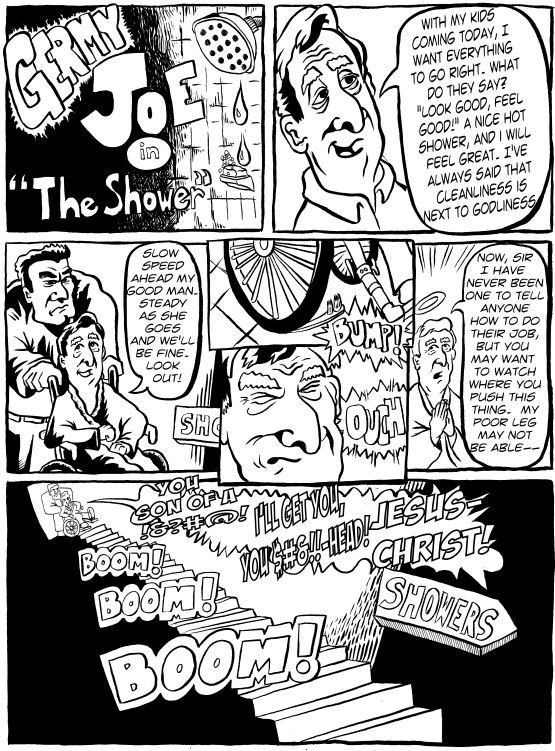
The piece below I did for my grandfather (now deceased).  He spent many, many days and weeks and months in hospitals.  He survived the Depression, WWII, multiple forms of cancer and medical mistakes, he had part of his lung taken out, and he had a fake hip, femur, and knee.  He complained all the time, but he was tough and quick with a joke, too.  At a family event, he was looking at my arms, and commenting on how hairy they are (and remembering the fact that I was over 2 weeks late being born), he said, "You know, if you would have stayed in the womb any longer, you would have come out a dog." And of course he said this while holding my arm and flashing a grin to the rest of the family.  He was a ham.  And he was also a born storyteller.  So, as a tribute to him, and to get him to laugh, I gave my grandfather this comic.  It is filled with many inside family jokes and it is a retelling/exaggeration of story he told the family about getting a shower at the nursing home, which of course was an exaggerated story to begin with, so there is some great double-exaggeration going on here.  Things to keep in mind: my grandfather was famous for saying "Jesus Christ!" and the phrase "Do you think I just fell off the back of the turnip truck?", which he would embellish with more colorful language.  And one of his family nicknames was "Germy Joe," due to the fact that he would instill germaphobia in his family by telling horrific stories of diseases and disasters caused by things like not washing your fruit.
The piece below is different.  I am the king of beginning projects and letting them languish and then remain unfinished.  I love to come up with good ideas and then let them linger as undeveloped ideas that go nowhere.  When I actually complete a project, from start to finish, you know that I was very powerfully motivated.  So, this piece has no dialog, no captions, it was meant for one purpose: for my dad to get better.  That didn't happen, but this blog, and the art projects that I have completed would not have happened if not for the piece pictured below.
This piece is not without its faults.  But I considered it done, complete, exactly as I wanted it.  It was drawn in pencil, inked in with marker, and colored with marker.  The yellow I believe was done in highlighter.  It was supposed to be part scientific illustration (the inset depicting white blood cells attacking and eliminating cancerous cells), and part fable, good vs. evil.  It hung on my dad's hospital room wall as a visual image to focus on and keep his mind on recovery.

So, focusing on the big historical events is very good.  We have to remember the horrible things that happen on the global scale, but for every huge world-altering event, there are a million smaller events affecting people of all ages and backgrounds across the world.  And heartbreak, or divorce, or the loss of a loved one is just as serious as international historical events, and serious comics cannot be summed up with Art Spiegelman's Maus just as comics as a genre of art and publishing cannot be summed up with X-Men or Spider-Man.  Personal pain and trauma can be expressed through image, text, song, and countless other forms, and no genre or artform should be kept from being considered as a valid outlet of those emotions and experiences.

Tuesday, March 1, 2011

A Simple One Panel Cartoon (Or Is It A Comic?)

Comics Vs. Cartoons again.  Theoretically, Comics as form is "sequential art."  More than one panel.  Time passes, even if it is just a moment, between those panels.  So, time moves, there is transition, movement in the sense of movement through time.  We have comic strips like Superman, Peanuts, and Shoe all on the funny pages of our newspapers.  We have comic books like Superman again, X-Men, Spider-Man, Rasl (have to plug Jeff Smith's Rasl).  Comics do not need to have words or dialog but there is a presumption of sequence, i.e., sequential art.

And then we have Cartoons.  Cartoons can mean the animated cartoons of Bugs Bunny, Tom & Jerry, Duck Tales (personal childhood favorite), or Bob's Burgers (currently loving that show, by the way).  But it can also mean a one-panel illustrated piece of art, perhaps with a caption or thought/speech balloon.  Think political cartoons, this time on the opinion page of our newspapers.

But what about The Far Side?  One-panel, sometimes with dialog, sometimes with a caption, but it's a comic strip, right? Or a comic.  Or is it a cartoon?  What about the below?

Not my finest work I will grant you, but it fits in with my discussion with myself.  One panel, not multiple panels, but there are two speech balloons.  Does the presence of two speech balloons or dialog of any kind imply movement through time?  Does that make it sequential art despite there being only one panel?  I don't know.  I did this piece with pen and brush on the left hand side and brush only on the right. This was done to give the left hand subject a more detailed, gritty look.  Brown as a color is gritty like dirt.  The reddish-orange color used on the left is an earth tone, maybe even a color connoting blushing due to embarrassment? Whereas blue, done in sharper more flowing strokes has literally a "cooler" feel to it: cool blue colors, cool people, cool music notes hovering in the air.  Does the color choice and its change from left to right denote movement in time or space, making it sequential?  I don't know.

It is possible that the whole comics vs. cartoons definition is solidly figured out, and I am just behind the times, but it wouldn't be any fun just writing down a definition, right?