Wednesday, June 29, 2011

Making an Interview Feature Graphic (Process)

I would like to feature more interviews on this site, so I figure that I should have a custom graphic to have at the top of the interview.  That way someone visiting the site will know that it is an interview.  It's only polite.  I started off with a thumbnail in my Moleskine mini-sketchbook.  I knew I wanted it to resemble kind of a late night talk show, with Philly as a background, and something to be generic (in terms of being able to use for multiple interviews) but specific as well.
Step 1: Moleskine thumbnail (more palm-sized than thumbnail sized)

So, I wanted the guest to be a black and white outline: first to stand out against the color background, but also so it would prompt the question "who is the interview with this time?"  My cartoon interpretation of the Philly skyline, me in a suit with an old-timey microphone.
Step 2: Non-reproducing blue colored pencil sketch
So, I have made myself rounder and more cartoony.  My guest is no longer slumping and slouching like in the larger than a thumbnail sketch.  And I am looking more into the camera than at my guest interviewee.  Philly is more defined, but still inaccurate, which is fine by me. The blog has roughly a 575px width, and I wanted something like a 16:9 ratio, so I worked horizontally.  But I already have a problem: this is not 16:9 or even close.  This is more like a 4:3 ratio.  Not quite what I wanted, but I don't want to have to use filler to fill in the blank spaces if I go back and work wider.  I figure that the graphic will be bigger than I originally thought, or I will include text or something else on the right or left hand side, forcing it to be a wider, more horizontal graphic.
Step 3: Inked-in version of blue pencil sketch
So, with the exception of one of my thumbs, I like how this turned out.  No Wite-Out used to correct anything. I really like how the Blick "Wonder White" brush performed.  I will definitely be using it more often. Now on to the coloring process.

So, here it is.  I used more patterns than I originally intended, but I like how the wood of the table turned out. The pattern for the suit and the star pattern is kind of a cheat, but again, I like the results.  I still have to play around with making it more horizontally longer, maybe by adding something to the right or left border.  I don't want the graphic to overwhelm the text.  It is supposed to be a re-usable graphic for my interview feature, so it should be recognizable, but the point is to feature the interview.  You will see what I do with it in my next post when I feature an interview.

Tuesday, June 21, 2011

Midsummer Night

Tonight (June 21st, 2011) is the beginning of Midsummer.  Summer begins today, it is the longest day of the year, and throughout human history it has been seen as an opportunity to get a little crazy, indulge in play-acting and fantasy, and take a break from the quotidian reality we have to deal with every other day of the year.

The Bard knew this.  His A Midsummer Night's Dream is probably my favorite Shakespeare comedy.  It does not have the one-liners and zingers like some of his other comedies or comedic scenes in his histories, but it is about the power of imagination, and I like it.  It, too, is about getting a little crazy, going off into the woods and having some fun.  It has also provided us with some great examples of art and illustration.  Shakespeare himself uses the word "transformation" in his play, and I like that specific word.  The play in some ways is about the power of the imagination, particularly that of the poet (a tip of his own hat) to provide words (spoken verbally or read in print) and have the audience transform those heard or read syllables or squiggly lines into visions and emotions.  An artist also has to be able to envision a work in the mind, believe in the vision and him or herself as an artist in order to complete the vision.  There is a truly a transformation of idea (vision, feeling, emotion, concept) into art (some physical representation of that idea).  And there is no guarantee that the observer of that art will transform that work into a specific thought or emotion.  It is up to the audience/viewer.
Titania and Bottom, oil on canvas, c. 1790 by Henry Fuseli (1741-1825)
Above is Henry Fuseli's painting, Titania and Bottom.  It is housed at the Tate Britain Museum.  From the Tate's website:
Fuseli first read Shakespeare's plays as a student in Zürich. This painting illustrates the scene in A Midsummer Night's Dream in which the Fairy Queen Titania is punished for her pride by her husband Oberon. He casts a spell which makes her fall in love with Bottom, whose head has been magically replaced by that of an ass. Here Titania orders her fairies to serve his every whim. Shakespeare's enchanted realm held a special appeal for Fuseli, allowing him to explore the supernatural world. This painting was commissioned by the publisher John Boydell as part of his 'Shakespeare Gallery' (From the display caption September 2004).
I can't imagine that this was what Fuseli saw when he saw a performance of Midsummer.  By the look of it, this scene would have been too complex and costly for an 18th-century theater to produce, so we can assume that it is Fuseli's interpretation of the text of the play as he read it aloud or in his head.  He "transforms" what he sees in his mind's eye and painted it on the canvas.  I would argue that this painting is more about composition, light, and the human form rather than the characters or play itself.  I have never seen this painting in person, so I will leave further commentary to other art critics.  Tate's description mentions Boydell's Shakespeare Gallery, and I love including examples of printmaking and book illustration.  Here is the engraving after Fuseli's painting:
Engraved by Jean Pierre Simon (c.1750-1810)
An engraver is often commissioned to "copy" or "replicate" another work of art, but it should never be called "copying."  It takes enormous amounts of skill to create an engraving, let alone reproduce accurately another work of art.  To recognize the amount of effort and artistic skill for an engraving like this one, I wanted to give credit to the engraver, and show a detail of the engraving.

I have done etchings (another form of intaglio printing), and I know that it takes thousands of precise cuts to produce a work like this.  And then there is the art of wiping away ink from the plate.  It is crazy amounts of work.

Moving on to another artist, when it comes to book illustration, there aren't many more famous than Arthur Rackham.  His illustrations made the Peter Pan stories famous, and his ethereal and grotesque watercolor paintings have provided plenty of readers with wonderous visions (and sometimes nightmares).  Below is Arthur Rackham's interpretation of Bottom and Titania.  To me, this illustration communicates much much more of what is happening here.  Titania, madly in love, is running recklessly to the much larger and gruesome character of Bottom.  And Bottom's body language speaks volumes.  He is not seeing his love and running towards her.  His feet are pointed away from her.  His arms are tense.  He is turning around.  He seems startled and confused, which makes sense, because being in "the Woods" during Midsummer is about being confused, and having your expectations and reality turned on its head.

Humans have always been intrigued by transformations.  Men turn into vampires after being bitten, werewolves transform by the light of the moon, men turn into monsters after drinking potions.  Gods have often been half-human and half-animal.  The Greek gods would appear as animals (Zeus as a bull or swan) and one of the most famous Greek monsters was the Minotaur (head of a bull).  The Egyptians gods would have the heads of animals (Thoth had the head of an ibis).  There is something horrific to these half-human figures, but also attractive and alluring.  It's a reminder of our animal aspect.  They represent our basest character flaws and our highest powers of imagination.  Not only does Art allow an artist to transform his or her thoughts, ideas, and emotions into a communicable physical form to share with others, but Art also has the power to transform our deepest fears about ourselves into something we can laugh at and enjoy.  So, when you are partying off in the woods tonight and the rest of this week, remember to be grateful for poets and artists alike.  They allow us to fantasize about being lovestruck fools and complete asses, but keep us sane and human.

Sunday, June 19, 2011

Brush DeathMatch (Raphael Kolinsky Sable Extra Pointed #0 Vs. Dick Blick Wonder White #2)


I have been meaning to do this more often: get into the nitty gritty details of how I judge the value of a particular art tool.  I have been using the Raphael brand kolinksy sable extra-pointed #0 brush for my ink work for years now.

I heard about the brand and brush from some online site, claiming that this is the brush that the Kubert Brothers use.  You can't blink at that endorsement, so I bought one and have been using them ever since.  I like them better than more expensive Windsor & Newton brushes, so I have been pleased.  However, here are the issues I have with them:

1) Inconsistency: I have had several of these brushes over the years, and sometimes the brush is great and sometime it is not so great.  When you order online, you get what you get, and there is no "test driving" brushes in your favorite brand of ink at art stores, so you have to make due.  I have been disappointed with some brushes.

2)Natural hair is natural hair: Being natural hair, it is susceptible to wear and tear, degradation when exposed to chemicals like cleaners, and it becomes fickle in high humidity.

From DickBlick.com:
This hair comes from the Siberian and Manchurian Sable, better known under the name of Kolinsky. It is a small animal that lives in the coldest areas of these regions, giving it a very strong and dense hair, an ideal hair for watercolor. It has fantastic spring, snap, and color holding ability.
I have one Raphael sable brush that I am on the verge of trimming with a pair of scissors.  There is a a stray bristle or two that requires me to position the brush specifically with every stroke.  Otherwise, the stroke goes haywire and I don't like it.  I figure since it is not the brush I prefer, even if I mess it up by taking the scissors to it, then I can just use it for something else, just not my finished lines.

I happened to be browsing the Philadelphia Dick Blick store and I came across a tiny, inconspicuous white plastic bin with small white-bristled brushes.  The "Wonder White" it is called.  Interesting.  Looks synthentic, but I like the edge to the bristles and the handle is short.  I cannot stand those long-assed handle brushes.  I hold my brush like a pencil for the most part, so I prefer a shorter handle.

Here is what I like:


1) The Up-and-Down Test:  So far, I really like how the brush provides a clean and similar brush stroke going either up or down.  Sometimes, because of the individual brush, I find myself only using up-strokes and having to position and angle the brush in a very specific way to get the stroke I am looking for.


2) The line:  It's a good line brush.  I bought it for use with thin lines, and it is getting the job done.

From DickBlick.com:
Dick Blick's White Taklon has a texture and responsiveness comparable to red sable, but with greater durability. The sharp point has good spring and is great for all water-based media. (Expect some staining of the filaments that won't harm the performance of the brush, just the appearance.)
I tried to replicate similar strokes and items I use a lot: letters, simple faces, curvy lines, lines right next to other lines.  The extra pointed kolinsky is clearly more pointed than the Wonder White, which is great if you have excellent brush command and you can lay down very quick and precise strokes--they look great (not seen here).  The Wonder White definitely has more resistance to it, which means you can put the brush on the paper and pull the brush.  This means you can apply more pressure and you can work more slowly (and advantage over the kolinsky).  The down side is that the Wonder White's lines were looking to me like pen lines, which is fine, but often I will use brush because it is distinguishable from pen.

So, there you go.  I think I have to switch to the Wonder White for a while anyway.  At the very least I will pick up a spare and use it more often.  It works nicely, has a longer ferrule, and is cheaper than the Raphael kolinsky.  That is a winning combination.  And as any artist knows, you really don't know a brush or a pencil or any other media until you've tried it out and compared.  Not quite the Death Match I was looking for with a clear and definitive winner and one loser being trashed, but I am still glad I did it.

Have a favorite brand of paint brush?  Let me know which and why!

Saturday, June 18, 2011

New Book Announcement

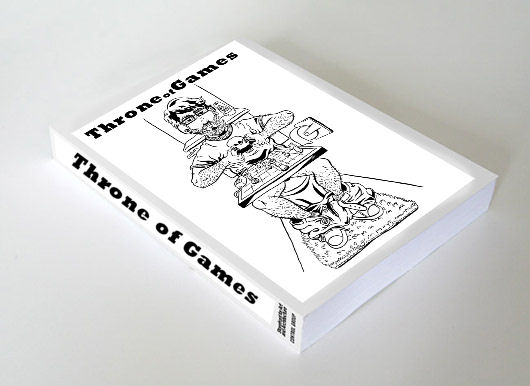
Everyone seems to be talking about the (George*) R.R. Martin turned HBO series Game of Thrones these days, and why not?  Great book, great series so far.  Well, I have an announcement to make about a new book called Throne of Games.  It's about an enchanted toilet that allows those who sit on it to rule in any games being played, whether it be chess, Risk! or computer games.  But you have to be sitting on the toilet.  So, basically it will be an epic saga of gamers trying to gain the seat of power.  Here is a sneak preview of the book cover.
*My dickhole of a friend pointed out that I left out Martin's first name.  Thanks so much.

Tuesday, June 14, 2011

Beer Fest Poster (Draft #1)

It's time for Pour-A-Palooza again.  In conjunction with The Ferment Nation, I have designed two posters for this annual beer fest.  The first one was inspired by Soviet propaganda posters and got rave reviews from fest-goers and the design department of the PJ's Group.
Hand-drawn figure, vector added letters, stars, colors, and half-toned shadows and highlights.  I had a vision and I made it happen.  I was very pleased with this one.  The next year I kind of wanted it to pair up in some way with the first poster.  I went with USA propaganda instead.  Commonly mistaken for Rosie the Riveter, I based it on the "We Can Do It!" poster.

This felt a little forced, I will admit.  It still incorporated a hand-drawn element with color and design elements added in Paint Shop Pro, but it was derived from a specific piece of art, whereas the first poster was inspired by a body of work.  This year I am lazy and the event is coming up quick, so I went with a very colorful photo montage.
I asked for and received very helpful commentary/critique from a fellow designer and professional photographer and semi-professional beer drinker.  I will post the second draft when it is ready.

Sunday, June 12, 2011

Philadelphia in Springtime (Mostly Final Version)

Although I may go back and add some halftone layers to this and make the light-green / white highlights more uniform across all three images, I consider this to be done.  At the very least I am satisfied with the inks and the text.  Went with green color scheme for Spring.
Philly in Springtime Page 1
Philly in Springtime Page 2
Philly in Springtime Page 3
Am I wearing a jacket in some panels and just a shirt in others?  Yes.  Consistency is difficult, and I can be lazy about it.  Did I not draw hair lines in the beard in the third page?  Right again, but I like I said, who needs consistency.  I will say this, too.  I have depicted in this final page, Rittenhouse Park in Philadelphia, but I sure as hell wasn't going to take pictures and then re-draw a photo.  This is the Rittenhouse that exists in my mind, and that is good enough.  I also drew segments of the park in my Satan and Gandhi Comic.  Now it's on to Summer.

Two Unforgivable Oversights: 1) I ignored my own rule of 3.  I will need to go back and add a light green highlight to go along with the midtone and shadow.  2)I never signed my name or initials on any of the 3 pages.  Not good.

Wednesday, June 1, 2011

Creepy Basement

So, this is another piece from the Groan Folks project.  The whole work is about revisiting the creepy places that you grow up experiencing and sometimes seeing them in a new light (and sometimes not).  Basements are creepy.  The basements I grew up with had pipes and exposed beams and rust and some mold and wooden benches and shelves and all kinds of gnarly stuff.  And there was never sufficient lighting, which did nothing but cause even creepier shadows to play on the walls and among the pipes.
The basements I know also had breaker boxes with deadly warnings inside them.  So, this is where I started.  From there, it became a game of playing with shadows. If there was an opportunity to place something creepy or visually confusing in the shadows then I made it happen.  Below is a detail of this piece that shows some of the shadow play, but I could have easily zoomed in on other parts of this.  There is a shadow behind the pipe on the left that actually ties in with another figure in another illustration in the same book.  There is also a shadow hiding in the window in the upper right hand corner.

Above I purposefully went with three creepy characteristics.  The first and easiest to see is the shadow of the pipe helping to blow out the candle.  It is easy for a crusty, rusty, old-timey pipe to have a face-like shadow, so that was easy.  The second is the face in the pipe itself, in the bottom right corner.  I tried to make a pair of eyes and a nose with keeping with the shading I was doing.  The third, I kind of did by accident.  The black, gooey dripping from the pipe (left) seemed to me to be human in shape, kind of upside-down human stick figures, so I went with it.  The shading in the background uses pencil on its side, blended multiple times.  I then did a rougher kind of shading on the pipe and used a kind of Edward Gorey style lines for the breaker box.